

!Mira que luna! Look at that moon! Resources for learning English

Fernando Olivera: El rapto.- TEXT FROM THE NOVEL The goldfinch by Donna Tartt (...) One night we were in San Antonio, and I was having a bit of a melt-down, wanting my own room, you know, my dog, my own bed, and Daddy lifted me up on the fairgrounds and told me to look at the moon. When "you feel homesick", he said, just look up. Because the moon is the same wherever you go". So after he died, and I had to go to Aunt Bess -I mean, even now, in the city, when I see a full moon, it's like he's telling me not to look back or feel sad about things, that home is wherever I am. She kissed me on the nose. Or where you are, puppy. The center of my earth is you". The goldfinch Donna Tartt 4441 English edition
Showing posts with label Sayings. Show all posts
Showing posts with label Sayings. Show all posts
Sunday, January 29, 2017


Thursday, May 26, 2016


Saturday, February 20, 2016
Vocabulary: triangle
tri‧an‧gle[countable]
1 a flat shape with three straight sides and three angles
2 something that is shaped like a triangle :
 a triangle of land
a triangle of land
3 a musical instrument made of metal bent into the shape of a triangle. You hit it with a metal stick to make a ringing sound.
4 American English a flat plastic object with three sides that has one angle of 90° and is used for drawing angles [= set-square British English]

Sunday, December 15, 2013
STRIKE WHILE THE IRON IS HOT

Strike while the iron is hot
Possible interpretation: Seize the opportunity! When we have the chance to do something, we should do it immediately. Otherwise it will be too late.Note: strike (verb) = hit very hard and deliberately | iron (noun) = a strong, hard, grey metal
Origin: This saying refers to the blacksmith who works with iron. First he heats the iron until it is red hot and soft. Then he immediately hits the iron with his hammer to change its shape. If he waits, the iron becomes cold and hard again, and he cannot shape it.
Origin: This saying refers to the blacksmith who works with iron. First he heats the iron until it is red hot and soft. Then he immediately hits the iron with his hammer to change its shape. If he waits, the iron becomes cold and hard again, and he cannot shape it.
Quick Quiz:
The saying "Strike while the iron is hot" advises us to
a. go on strike b. use a hot iron c. seize opportunities |
Englishclub.com
Friday, December 13, 2013
Give a thief enough rope and he'll hang himself.
Give a thief enough rope and he'll hang himself.

Note: rope (noun) = a long piece of strong cord | hang (verb) = kill a person by putting a rope around their neck and letting them drop
Possible interpretation: A bad person will sooner or later be the cause of his own downfall.
Quick Quiz:
If "Give a thief enough rope and he'll hang himself" is true, what will happen to a bad person who is not challenged? In the end, he will get himself
ENGLISHCLUB.COM
|
Tuesday, December 10, 2013
You can lead a horse to water, but you can't make it drink
You can lead a horse to water, but you can't make it drink

Possible interpretation: You can show people the way to find something or to do something, but you cannot force them to act after that.
Quick Quiz:
"You can lead a horse to water, but you can't make it drink" suggests that
www.englishclub.com
|
Monday, December 9, 2013
Ignorance of the law is no excuse
Ignorance of the law is no excuse

picture source:
Possible interpretation: It is no defence to say that we didn't know that something we did was illegal.
Note: ignorance (noun) = lack of knowledge | the law (noun) = the system of rules recognized and enforced in a particular country | excuse (noun) = a reason or explanation given to defend a (wrong) action
Quick Quiz:
If "ignorance of the law is no excuse", a judge is most likely to find someone not-guilty if he can prove that
www.englishclub.com
|
Sunday, December 1, 2013
FAMILIARITY BREEDS CONPTEMT.- SAYING

Familiarity breeds contempt
Possible interpretation: When we know someone or something very well, we lose respect for them or it.Note: familiarity (noun) = close knowledge of someone or something | breed (verb) = cause (something) to happen over time | contempt (noun) = a feeling that someone or something is not worth our respect
Quick Quiz:
The saying "familiarity breeds contempt" suggests that we have less regard for people or things that
a. we don't know b. we don't respect c. we know very well |
Wednesday, November 13, 2013
He that wills the end wills the means
He that wills the end wills the means
Quick Quiz:
The saying "He that wills the end wills the means" is referring to someone who is
englishclub.com
|
Tuesday, May 7, 2013
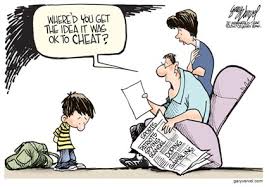
The end justifies the means
Possible interpretation:

www.sodahead.com
blogs.ksbe.edu
If our objective is good, then it doesn't matter if the way we achieve it is bad or wrong or evil.
Note: end (noun) = goal; objective; result | justify (verb) = prove or show to be reasonable or right | means (noun) = method; way of doing something | Conflicting proverb: "Never do evil that good may come of it."www.sodahead.com
blogs.ksbe.edu
If our objective is good, then it doesn't matter if the way we achieve it is bad or wrong or evil.
Quick Quiz:
The government says that "the end justifies the means," so killing one thousand people to save one million people will
englishclub.com
|
Monday, April 15, 2013
DAILY UPDATED SAYING WITH PICTURES. Death pays all debts
Possible interpretation: Dying cancels everything, including anything that we owe to other people.
Note: death (noun) = the act of dying; the end of life | Death (noun) = personification of the force that destroys life | debt (noun) = something (for example, money) that is owed or due

Picture source: www.flatfiles.pierogi2000.com
Quick Quiz:
If "Death pays all debts" is true, when we die all our bills are
Source: www.englishclub.com
|
Friday, December 7, 2012
Every dog has his day.
Every dog has his day

hyzazesaluj.herobo.com
Origin: The medieval Dutch scholar Erasmus suggests that this saying had its roots in the death of the Greek playwright Euripides. In 405 BC Euripides was killed by dogs set on him by a rival. The proverb was first recorded in the first century by the Greek biographer Plutarch as: "Even a dog gets his revenge." In 1539 Richard Taverner published it in English as: "A dogge hath a day." And in 1670 John Ray's "A Collection of English Proverbs" had it as: "Every dog hath his day."Possible interpretation: 1) Even the lowest of us at some time has a chance to get revenge on an oppressor, no matter how powerful that oppressor may be. 2) We will all have good luck or success at some point in our lives.
Quick Quiz:
"Every dog has his day" is a proverb about
|
Tuesday, July 10, 2012
DAILY SAYING WITH PICTURES. One good turn deserves another

Picture source: http://www.cbarks.dk/thecharitystories.htm
Possible interpretation: If someone helps you, they merit being helped in return.
Note: good turn (noun) = favour; act of helping
Quick Quiz:
You might say "one good turn deserves another" to
Source: www.englishclub.com
|
Wednesday, June 20, 2012
The tide must be taken when it comes. SAYING. 21-05-2011.
The tide must be taken when it comes
Possible interpretation: We should
use all opportunities when they come, before it's too late.
Note: (the)
tide (noun) = the rising and falling of the sea caused by the attraction of the
moon and sun | Compare: "There is a tide in the affairs of men, Which
taken at the flood, leads on to fortune..." (from "Julius
Caesar" by William Shakespeare 1564-1616)
Origin: Ships
(especially in the old days) often need a high tide to leave or enter port. Man
cannot control the tide, so when it comes ships have to use the opportunity it
gives them without delay.
Quick Quiz:
"The tide must be taken when it
comes" is a saying suggesting that we
wait for opportunities
look for opportunities
act on opportunities
|
Principio
|
ENGLISHCLUB.COM
Thursday, March 15, 2012
We must learn to walk before we can run

isoscratch.exblog.jp
isoscratch.exblog.jp
Possible interpretation: We have to be patient when learning. Babies crawl before they walk. And children walk before they run. We cannot do difficult tasks before we can do easy tasks.
Quick Quiz:
If "we must learn to walk before we can run", what must we learn to do before we can write?
www.englishclub.com
|
Monday, February 27, 2012
He who pays the piper calls the tune

davidicke.com
Possible interpretation: The person who pays a musician can decide what music he wants to hear. And the person who pays for any service has the right to say exactly what he wants.
Note: piper (noun) = a person who plays the pipe (a musical instrument) | tune (noun) = a melody; a piece of music
Quick Quiz:
Mark tapped his wallet and said to his friends, "He who pays the piper calls the tune", meaning that
Source: www.englishclub.com
|
Saturday, February 18, 2012
Proverbs
"As you sow, so shall you reap." (English proverb)
"As long as there will remain two men on Earth, Jealousy will reign" (Breton proverb)
"If there's no choice but advice, ask for the decisiveness of an advisor or the advice of a decisive person." (Arabic proverb)
"He who digs a pit for another falls into it himself." (Czech proverb)
Source: http://www.audioenglish.net/dictionary/scrounger.htm
"As long as there will remain two men on Earth, Jealousy will reign" (Breton proverb)
"If there's no choice but advice, ask for the decisiveness of an advisor or the advice of a decisive person." (Arabic proverb)
"He who digs a pit for another falls into it himself." (Czech proverb)
Source: http://www.audioenglish.net/dictionary/scrounger.htm
Friday, February 3, 2012
Once beaten twice shy

ed.wikia.com
Possible interpretation: If an animal (such as a dog) bites you one time, you will be extra careful the next time. This sayings talks about learning from our mistakes.
Note: once (adverb) = one time | twice (adverb) = two times | shy (adj.) = reserved; timid; reluctant | Also: "Once bit, twice shy" and "Once burned, twice shy"
Quick Quiz:
If you are "once bitten, twice shy", you
source: englishclub.com
|
Monday, January 23, 2012
Rome wasn't built in a day

Picture source: teevault.com
Possible interpretation: All things take time to create. And great things like the city of Rome take a very long time. So we shouldn't expect to accomplish something or achieve success immediately.
Note: Rome (proper noun) = the capital city of Italy, founded according to tradition by Romulus in 753 BC | built = constructed; made
Quick Quiz:
source: englishclub.com
Angela told her son that "Rome wasn't built in a day" when he
|
LEARNING ENGLISH READING ABOUT PROVERBS.A CAT MAY LOOK AT A KING.

Meaning An inferior isn't completely restricted in what they may do in the presence of a superior. Origin The origin of this proverb is unknown. What is known is that it is found first in print in a famous early collection of English proverbs, The Proverbs And Epigrams Of John Heywood, 1562: Some hear and see him whom he heareth nor seeth not But fields have eyes and woods have ears, ye wot And also on my maids he is ever tooting. Can ye judge a man, (quoth I), by his looking? What, a cat may look on a king, ye know! My cat's leering look, (quoth she), at first show, Showeth me that my cat goeth a caterwauling; And specially by his manner of drawing To Madge, my fair maid.
 In 1713, Oswald Dykes published English proverbs with moral reflexions. This used various well-known proverbs as a starting point for Dykes' to pronounce his political and social values. In this extract it isn't clear which king he was protecting, as Queen Anne was the British monarch at the time: Tis very true, Kings do not use to call Cats to an Account for their looks, or their undistinguishing Boldness: But there are many Cats of this Kind, which are too much made of, indulg'd, and encourag'd, 'till they fly at last in the Face of sacred Majesty. In this Sense, it is a true-blue Protestant-Proverb. I do not know whether it was calculated for the Rabble or not; to pur and mew like Cats about a Throne, 'till at length they scratch the Hand that strokes them, and mob their Protector. However, there has been ill use made on't; and it has often been extravagantly misapply'd to Outrage and Violence upon a King's Person, as well in Print, as in some Peoples Mouths.
PHRASES.


PHRASES.

Subscribe to:
Posts (Atom)